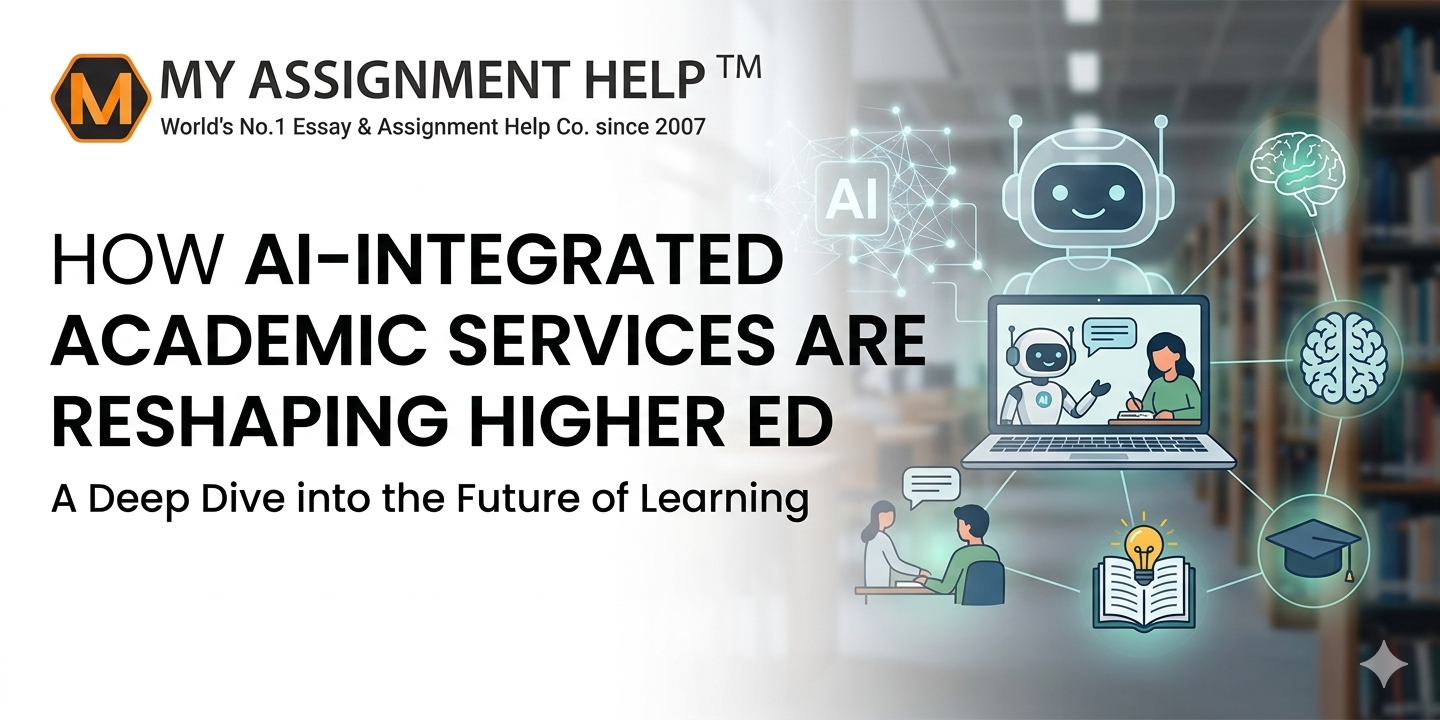
The ivory towers of academia are experiencing a digital structural shift. For decades, the traditional model of higher education—lecture-based instruction, manual research, and standardized testing—remained largely unchanged. However, the integration of Artificial Intelligence (AI) into academic services has moved beyond a mere trend; it is now the primary engine of a pedagogical revolution.
As we move through 2026, the conversation has shifted from “Can AI be used?” to “How is AI optimizing the student journey?” From personalized learning paths to agentic AI grading systems, the landscape is being redesigned to prioritize high-level cognitive skills over rote memorization.
The Personalization Pivot: Adaptive Learning Environments
Traditional classrooms often struggle with the “one-size-fits-all” limitation. AI-integrated services are dismantling this barrier by providing hyper-personalized support. Machine learning algorithms now analyze a student’s past performance, reading speed, and comprehension gaps to deliver tailored resources in real-time.
This level of customization is particularly vital in rigorous academic environments. For instance, international students often seek specialized support to navigate different regional grading standards. Whether a student is tackling complex engineering modules or seeking myassignmenhelp for assignment help Canada-specific curriculum requirements, AI tools provide the foundational scaffolding needed to bridge the gap between classroom theory and practical application. By streamlining the “busy work” of research and citation, students can spend more time on critical analysis and synthesis.
Data-Driven Performance: The Rise of Predictive Analytics
Higher education institutions and academic support services are now utilizing big data to predict student outcomes before the final exam. Predictive analytics can identify students “at-risk” of falling behind by monitoring engagement metrics and formative assessment scores.
- Early Intervention: According to a 2025 study on EdTech efficacy, institutions using AI-driven early warning systems saw a 12% increase in retention rates.
- Skill-Gap Mapping: AI services can now map a student’s current assignment performance directly against industry-standard skills, highlighting exactly what a learner needs to master for the 2026 job market.
Beyond the Chatbot: Agentic AI in Research and Writing
The initial fear surrounding AI in academia focused heavily on academic integrity. However, the focus has matured into “Human-AI Collaboration.” Modern academic services use AI as a research partner—a tool that can synthesize thousands of peer-reviewed journals in seconds without losing the nuances of human argumentation.
For students exploring niche fields, these tools are invaluable. For example, a student looking for child development research topics can use AI to identify emerging trends in neuro-linguistics or social-emotional learning, providing a springboard for original, human-led research. This ensures that the student is not starting from a blank page but is instead standing on a foundation of data-driven insights.
The “Skills-First” Economy and Academic Support
By the end of 2026, the “Skills-First” economy will value demonstrated competency over prestige. AI-integrated services are pivoting to support this by offering:
- Simulation-Based Learning: AI-driven environments for medical, legal, and engineering students.
- Real-Time Feedback: Instead of waiting weeks for a professor’s notes, AI agents provide instant feedback on tone, structure, and logic.
- Language Localization: Bridging the gap for ESL students by translating complex academic jargon into comprehensible insights without losing the original context.
Ethical Implementation and EEAT Standards
As a senior content lead in the academic space, I emphasize that the integration of AI must follow the EEAT (Experience, Expertise, Authoritativeness, and Trustworthiness) framework.
- Experience: Services must be backed by human subject matter experts who vet AI-generated data.
- Expertise: High-level academic writing requires a nuance that AI alone cannot replicate—specifically in emotional intelligence and cultural context.
- Authoritativeness: Utilizing verified sources such as JSTOR, Google Scholar, and university repositories.
- Trustworthiness: Ensuring data privacy and maintaining strict adherence to university honor codes.
Key Takeaways
- Personalization is King: AI allows for individual learning speeds, reducing student burnout.
- Human-AI Synergy: AI is a tool for augmentation, not a replacement for critical thinking.
- Data-Backed Growth: Predictive analytics are significantly improving graduation and retention rates.
- Ethical Evolution: Academic services are adopting rigorous standards to ensure AI is used as a research aid, not a shortcut.
Frequently Asked Questions
Q1: Does using AI-integrated services count as plagiarism?
No, when used ethically. AI should be used for brainstorming, structuring, and finding sources. Professional services ensure that the final output is human-written, original, and properly cited.
Q2: How does AI help in complex subjects like Law or Nursing?
AI can quickly parse through massive legal databases or clinical case studies to find relevant precedents or symptoms, which the student then analyzes to form their own conclusions.
Q3: Is AI-integrated help available for specific regions like Canada or the UK?
Yes. Modern services use localized AI models that understand specific regional requirements, such as AGLC4 for Australian Law or APA 7th edition for North American universities.
Author Bio
James Sterling is a Senior Content Strategist and Academic Consultant at MyAssignmentHelp. With over 12 years of experience in higher education and EdTech strategy, James focuses on the intersection of Artificial Intelligence and student success. He is a frequent contributor to discussions on the “Skills-First” economy and the ethical implementation of AI in the classroom.
References:
- Gartner (2025). The Future of Higher Education: AI and the Student Experience.
- Journal of Educational Technology (2026). Predictive Analytics and Retention in Post-Secondary Institutions.
- World Economic Forum (2024). The Skills-First Economy: Transitioning the Global Workforce.