Take a moment and think about your last hour. Chances are, you checked your phone more than once. Maybe you watched a short video, read a news headline, listened to a song, or scrolled through a few photos. None of that felt unusual. It felt normal. And that’s exactly the point.
Digital content consumption simply means how we take in information and entertainment through screens: videos, music, articles, games, photos, and everything in between. Not long ago, most of this happened on a desktop computer, usually at home or at work. Today, it happens everywhere: on the bus, in bed, standing in line at a grocery store, or waiting for coffee.
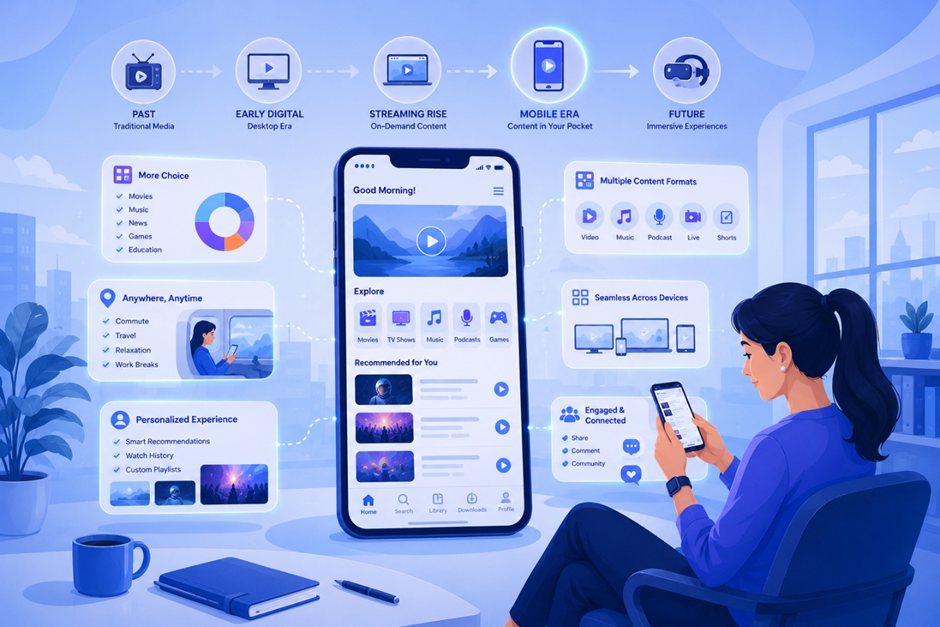
The mobile era changed all of this. Smartphones didn’t just make phones smaller and smarter. They moved the entire digital world into our pockets. A device that once made calls and sent texts now streams movies, teaches languages, tracks workouts, and lets us talk to people across the globe in real time.
This shift didn’t happen overnight, but it happened fast enough to reshape entire industries. In this article, we’ll walk through how mobile technology transformed the way people find, use, and create content, and what that means for how we live, learn, and unwind.
Understanding Digital Content Consumption
Before we go further, let’s slow down and define things clearly.
Digital content is any information delivered through electronic devices instead of paper or physical formats. It includes:
- Videos, from movie streams to ten-second clips
- Audio: songs, podcasts, audiobooks
- Text: articles, e-books, blog posts, messages
- Images: photos, memes, digital art
- Interactive content: games, quizzes, live streams
Content consumption matters because it shapes how we spend our time, what we learn, and even how we feel. The average person today interacts with more content in a single day than someone a generation ago might have seen in a week.
Here’s the biggest difference between traditional and mobile consumption: traditional media was scheduled and passive. You watched the evening news at 6 p.m. because that’s when it aired. You bought a newspaper because that’s how you got the daily headlines. Mobile content, on the other hand, is available whenever you want it, shaped around your habits instead of a broadcaster’s schedule.
Smartphones didn’t become the center of digital life by accident. A few things had to happen first.
Smartphone growth exploded once devices became affordable enough for everyday households, not just tech enthusiasts. At the same time, mobile internet access became cheaper and more widely available, even in areas that never had reliable broadband.
Add to that a few key hardware upgrades:
- Faster processors meant phones could handle heavy tasks like video editing or gaming without freezing
- Bigger, sharper screens made watching content genuinely enjoyable instead of a squint-inducing chore
- Better batteries meant people could actually use their phones all day without panicking over a low battery icon
Put these pieces together, and you get a device capable of replacing a television, a stereo, a newspaper, a camera, and a game console, all at once. That’s not an exaggeration. It’s simply what happened.
The Shift from Desktop to Mobile
Desktop computers still have their place, especially for serious work. But when it comes to everyday content, mobile devices have taken over.
People now consume content through:
- Smartphones, the primary screen for most digital activity
- Tablets, a middle ground between phone and laptop, popular for reading and video
- Foldable devices, offering a bigger display that still fits in a pocket
- Wearables, smartwatches and fitness bands delivering bite-sized updates
Desktop experiences tend to be intentional. You sit down, open a browser, and focus on one task. Mobile experiences are the opposite: spontaneous, quick, and often squeezed into small gaps of free time. A five-minute wait at a bus stop is now enough time to read an article, reply to messages, and check the weather. That kind of flexibility is something desktops were never designed for.
If there’s one force that reshaped digital habits more than any other, it’s social media, and specifically, how it evolved for mobile screens.
Short-form videos turned scrolling into a habit rather than a task. Live streaming let creators connect with audiences in real time, no editing required. Stories, those disappearing posts many platforms now offer, made sharing feel low-pressure and casual.
Meanwhile, user-generated content and influencer content shifted trust away from traditional advertising. People increasingly listen to real users and creators instead of polished commercial campaigns.
Perhaps the biggest change, though, is the personalized feed. Instead of everyone seeing the same content, each person now sees a feed shaped by their own behavior: what they’ve liked, watched, and lingered on. This means two people scrolling the same app at the same moment could see completely different content. Information itself has become personal.
Video Streaming in the Mobile Era
Television used to mean sitting in front of a big screen at a set time. Now, video follows you.
Mobile devices deliver:
- Movies and TV shows through streaming apps
- Educational videos that turn any topic into a lesson
- Live events and sports, watched from a train seat or a waiting room
- Short-form video, built for quick entertainment between tasks
What makes this powerful is control. You choose what to watch, when to watch it, and how fast to watch it. Missed the start of a match? Rewind it. Want to binge an entire season in one sitting? Nothing’s stopping you. Your phone has effectively become a personal entertainment center that fits in your hand.
Sound content might be the most underrated part of this shift. Music streaming replaced physical albums and even downloaded MP3s with vast, searchable libraries available instantly.
Podcasts grew right alongside it, offering something music can’t always give: conversation, storytelling, and deep dives into niche topics. Whether it’s true crime, business advice, or comedy, there’s likely a podcast for it.
Audio content works so well on mobile because it fits into moments when your eyes and hands are busy but your ears are free, during a commute, a workout, or household chores. Add offline downloads, and you can enjoy hours of music or conversation without touching your data plan or worrying about a weak signal.
Mobile Gaming as Digital Content
Gaming used to require a console, a controller, and a television. Now, it just requires a phone.
Casual gaming brought quick, simple games to people who never considered themselves gamers. Competitive gaming turned mobile titles into serious esports with global tournaments. Cloud gaming now lets phones stream console-quality games without needing powerful hardware inside the device itself.
Social gaming adds another layer, letting friends play together or compete from different cities. And streaming gameplay, watching someone else play live, has become entertainment in its own right, proving that gaming isn’t just something you do anymore. It’s also something you watch.
Reading hasn’t disappeared. It’s just changed shape.
- E-books let you carry an entire library in your pocket
- Digital magazines deliver visual storytelling without the paper
- News apps push headlines straight to your lock screen
- Blogs cover everything from cooking to personal finance
- Comics and educational resources reach readers who might never have visited a physical bookstore
The biggest change here is accessibility. Someone in a small town with no bookstore nearby can now access nearly the same library as someone living in a major city. Reading has become less about where you are and more about whether you have a charged phone.
Personalized Content Through AI
Behind almost everything mentioned so far, there’s a quiet force at work: artificial intelligence.
Recommendation systems study what you watch, read, and click, then suggest more of what you’re likely to enjoy. Personalized feeds use the same idea to shape entire platforms around individual users. Smart notifications learn your habits and try to reach you at the moments you’re most likely to respond.
AI content suggestions and search algorithms work together behind the scenes, deciding what appears first when you open an app or type a question. Most people never see this process happening, but it directly shapes what content reaches them, and just as importantly, what content they never see at all.
Content Creation Has Become Mobile
Here’s something that would have sounded strange twenty years ago: almost anyone with a smartphone can now be a content creator.
People use their phones to make:
- Videos, from casual clips to polished productions
- Photos, edited right on the device
- Podcasts, recorded with nothing more than a phone microphone
- Blogs, written and published from a notes app
- Social media posts, shared instantly to a global audience
- Live streams, broadcast in real time to anyone watching
This shift blurred the line between consumer and creator. A teenager filming in their bedroom can reach millions of viewers. A small business owner can market their shop without hiring an agency. Creation used to require expensive equipment and technical skill. Now, it mostly requires a decent phone and a good idea.
None of this mobile flexibility would work without something happening behind the scenes: cloud technology.
Cloud storage means your photos, documents, and files aren’t trapped on one device. Cross-device synchronization lets you start watching a show on your phone and pick it up later on a tablet, right where you left off. Instant access means content loads the moment you want it, without needing to physically transfer files.
Online collaboration and file sharing have also become smoother, letting people work on shared documents or projects from completely different locations. The cloud is easy to overlook because it works quietly in the background, but it’s really the invisible foundation supporting almost every mobile content experience.
Most conversations about mobile content assume fast, steady internet. Across South Asia, Southeast Asia, and plenty of other regions, that assumption doesn’t hold up. Networks slow down without warning, data plans cost real money, and a stable connection isn’t something users can count on. For millions of people, planning around that isn’t an inconvenience. It’s just part of how a phone gets used.
A handful of tools grew directly out of that gap:
- Vidmate lets users save video and audio from a range of platforms so it’s ready whenever they need it, connection or not. For many, this isn’t a workaround, it’s simply how they’ve always used their phones.
- YouTube is still where most video discovery starts, shaping what people end up saving or watching later, even before offline access enters the picture.
- UC Browser builds downloading right into the browsing experience itself, so users don’t need to switch between a browser and a separate app to save something.
- Netflix takes a more built-in approach, letting subscribers download entire shows and movies directly within the app, no extra tool required.
- Spotify follows the same idea for audio, letting users save playlists, albums, and podcasts ahead of time so a commute or a weak signal never interrupts what they’re listening to.
Different apps, different approaches, but the same lesson runs through all of them: offline access isn’t a niche feature reserved for edge cases. For a huge share of the world, it’s simply how digital content consumption works day to day.
Despite how connected everything feels, offline access still matters. Maybe more than people realize.
Downloadable content lets users save videos, music, and articles ahead of time. This becomes essential for offline videos, offline music, and offline reading, especially during travel entertainment on flights, long drives, or trips to areas with weak signal.
Offline access isn’t just a backup plan. For many users, especially in regions with expensive or unreliable data, it’s the main way they consume content at all. Mobile technology succeeded not because it assumed perfect internet everywhere, but because it planned for the moments when connection isn’t guaranteed.
Benefits of Mobile Content Consumption
Stepping back, it’s worth appreciating what this shift has actually given us:
- Convenience: content available anytime, anywhere
- Accessibility: reaching people regardless of location or income level
- Personalization: feeds and recommendations shaped around individual taste
- Entertainment: endless options for relaxation and fun
- Learning: tutorials, courses, and educational content on demand
- Productivity: tools that help manage work and daily tasks
- Global connectivity: staying in touch with people anywhere in the world
These benefits explain why mobile devices became so central to daily life so quickly. They solved real problems and made everyday tasks noticeably easier.
Of course, this transformation didn’t come without a cost.
Screen addiction and digital fatigue have become genuine concerns, with many people feeling mentally drained after hours of scrolling. Privacy concerns have grown as apps collect more personal data than most users realize. Misinformation and fake news spread faster than ever, sometimes outrunning fact-checkers entirely.
Constant distractions make focused work harder to achieve. Mental health researchers continue studying the link between heavy mobile use and stress, anxiety, and sleep problems. On top of that, there’s a practical side too: battery dependence and internet dependency mean a dead phone or a weak signal can feel surprisingly disruptive to daily routines.
None of this means mobile technology is bad. It simply means the benefits come with responsibilities.
Responsible Digital Content Consumption
So how do we enjoy the advantages without falling into the pitfalls?
A few practical habits help:
- Manage screen time using built-in phone tools that track and limit usage
- Practice digital wellbeing by setting boundaries, like no phones during meals or before bed
- Review privacy settings regularly instead of accepting default app permissions
- Choose trusted sources for news instead of relying on random social posts
- Build healthy media habits, such as taking regular breaks from screens
- Manage notifications so your phone doesn’t control your attention all day
None of these require giving up your phone. They just require a bit of intention. Mobile technology works best when you’re the one deciding how it fits into your life, rather than letting it quietly decide for you.
The mobile era is still evolving, and a few trends hint at where things are headed next.
AI-generated content is becoming more common, from written articles to synthetic video. Augmented reality (AR) and virtual reality (VR) are pushing content beyond flat screens into immersive spaces, while mixed reality blends the two. 5G, and eventually 6G, promise faster, more reliable connections that could make streaming and cloud gaming feel instant, even on the move.
Hardware is evolving too. Foldable devices continue improving screen size without sacrificing portability. Smart glasses hint at a future where content appears right in your field of vision. Voice assistants are getting better at understanding natural conversation, and wearable technology keeps expanding beyond fitness tracking into everyday content delivery.
None of these technologies will replace the smartphone overnight. But together, they suggest that mobile content consumption isn’t slowing down. It’s simply finding new forms.
Looking back, it’s clear the mobile era didn’t just change what device we use. It changed our relationship with content itself. Entertainment, learning, work, and connection all now travel with us, available in the time it takes to unlock a screen.
That’s a remarkable shift, and mostly a positive one. But like any powerful tool, it works best when used thoughtfully. The goal isn’t to reject mobile technology or resist its convenience. It’s to stay aware of how it shapes your time, your attention, and even your mood, and to make sure you’re the one steering that relationship, rather than simply following wherever the feed leads.
Mobile devices gave us access to nearly unlimited digital content. What we do with that access is still very much up to us.
- When did mobile devices start overtaking desktops for content consumption? By the early 2010s, people were collectively spending more time on mobile devices than personal computers, and that gap has only grown since.
- Why did the infinite scroll change online behavior so much? By removing the natural stopping point of a page, it encouraged people to keep consuming content far longer than they would with a traditional, finite layout.
- What makes short-form video so popular on mobile? It asks very little of the viewer, delivers a complete experience in seconds, and moves automatically into the next relevant clip, making it almost frictionless to keep watching.
- Did short-form video kill long-form content? No. Podcasts and long-form journalism both grew during this same period, showing that audiences still want depth — they just access it through different formats now.
- Why did podcasts grow so much through mobile devices? Audio is the only major content format that doesn’t require your eyes, so it fits into commutes, workouts, and chores in ways video and text cannot.
- How does the content algorithm actually affect what I see? It tracks behavior like pauses, likes, shares, and watch time, then uses that data to build a personalized feed that may look very different from what someone else with similar interests sees.
- Has mobile technology actually reduced how much people read? No — people read more text daily than ever before. What’s changed is the pace and style of reading, not the overall amount.
- What role do apps like Vidmate or Snaptube play in mobile content consumption? They let users save video and audio content for offline access, which matters most in regions with slower networks or unreliable connectivity.
- Is personalized content always a good thing? Not entirely. While it makes content feel more relevant, it can also cause people’s information environments to diverge so much that shared cultural reference points start to erode.
- What’s coming next for mobile content consumption? Wearables, spatial computing, and AI are expected to shift content delivery beyond the flat screen, though the phone itself is expected to remain the dominant interface for the foreseeable future.