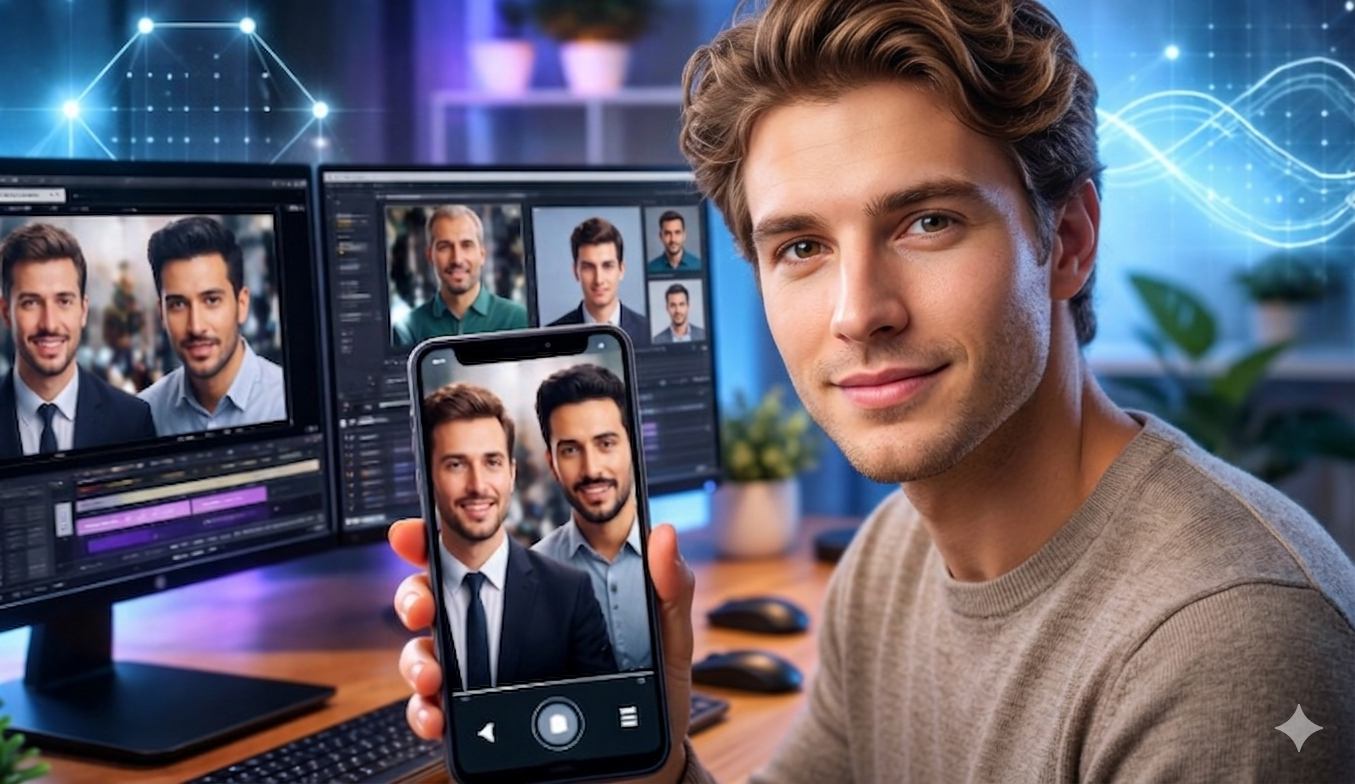
In today’s digital landscape, face swap videos have taken the internet by storm. From social media memes to viral videos, the ability to swap faces in videos has captured the imagination of creators and marketers alike. What once seemed like a gimmick or a feature for entertainment is now being used in professional and creative ways. But how does this technology work, and what makes it so accessible?
At the core of face-swap videos is Artificial Intelligence, a technology that has revolutionized the way we manipulate video and image content. AI-driven algorithms and neural networks have simplified the face swap process, enabling creators to seamlessly swap faces in videos with high levels of realism. Whether you’re a business looking to create engaging content or a content creator exploring new creative avenues, AI face swap technology is changing the way videos are made.
In this article, we will explore the underlying technology behind face swap videos, how AI is making this possible, and how platforms like Invideo are helping creators easily create AI face swap videos.
What Makes Modern Face Swapping Different from the Past
A decade ago, swapping a face in video footage required hours of manual frame-by-frame editing, expensive software, and a skilled team of VFX artists. The results were often noticeable, shaky, flickering, and unconvincing. Today, the story is entirely different.
The shift happened because of deep learning. Modern AI models are trained on enormous amounts of visual data, which allows these models to understand the geometry of a human face, where the eyes sit in relation to the nose, how the jaw moves when someone speaks, and how lighting falls across cheekbones. Once the model internalizes all of these aspects, it can map one face onto another with a level of precision that was previously unimaginable.
The key difference is not just quality. It is also speed and accessibility. What used to take a professional team days now takes seconds.
The Core AI Technologies Doing the Heavy Lifting
Neural Networks and Face Detection
Everything begins with face detection. Before any swap can happen, the AI needs to accurately locate and analyze the face in the source video. Modern neural networks can identify facial landmarks, the precise coordinates of the eyes, nose, mouth, chin, and contours of the face, even when the subject is moving, tilting a head, or partially obscured by hair or hands.
This is no small feat. A face in motion is constantly changing its angle, its expression, and its relationship to the light source. A well-trained model learns to track all of this dynamically, frame by frame, ensuring that the replacement face stays anchored correctly throughout the entire clip.
Generative Adversarial Networks (GANs)
One of the most powerful technologies behind realistic face swapping is the Generative Adversarial Network, or GAN. Think of it as two AI systems competing against each other. One system (the generator) creates the swapped face. The other (the discriminator) tries to tell if it is real or fake. Over time, through millions of rounds of this back-and-forth competition, the generator gets so good that even the discriminator cannot reliably spot the difference.
This adversarial process is what gives modern face swaps their photorealistic quality. The AI is not just pasting a face on top of another. It is generating an entirely new visual output that blends lighting, texture, skin tone, and expression into a cohesive whole.
Diffusion Models and Latent Space Manipulation
Recently, diffusion models have emerged. These systems work by gradually refining noisy, blurry images into sharp, detailed outputs. When applied to face swapping, diffusion models allow for incredibly fine-grained control over the final result, preserving the original actor’s expressions and head movements while replacing the appearance with another face entirely.
Latent space manipulation is another technique worth understanding. AI models represent faces as points in a high-dimensional mathematical space. Moving between these points allows the model to blend facial features, adjust skin tones, or adapt the source face to match the lighting conditions of the target video. The result is a swap that feels organic rather than pasted in.
Motion Sync and Expression Preservation
One of the hardest challenges in face swap technology is not the face itself. The real difficulty is keeping the swap believable in motion. A static swap might look convincing in a single frame, but the moment the subject speaks, blinks, smiles, or turns a head, any imperfection becomes glaring.
Advanced AI systems solve this through motion and expression synchronization. The model tracks not just where the face is, but how it is moving: the subtle muscle contractions that produce a genuine smile, the way eyebrows rise during surprise, the slight asymmetry of natural human expressions. The replacement face is then animated to mirror all of these movements in real time, creating a result that feels alive rather than mechanical.
This is also where flicker elimination becomes critical. In older face swap systems, slight inconsistencies between frames would cause the swapped face to appear to vibrate or shimmer. Modern AI handles the situation by maintaining consistency across frames, treating the video as a continuous sequence rather than a collection of isolated images.
Putting It All Together: From Upload to Output
The process is quite straightforward from a user’s perspective, even though the AI doing the work is remarkably complex.
It starts with a video to be transformed and a clear photo of the face to be introduced. The AI analyzes both, detects the facial landmarks in the video, and begins the mapping process. It adjusts for differences in skin tone, lighting, and head angle, then generates the new frames with the swapped face, frame by frame, while maintaining smooth motion and expression sync throughout the clip. For those who want to create an ai face swap video, platforms like invideo offer exactly this kind of end-to-end experience: upload the footage, select the face to swap, let the AI handle the heavy lifting, and download a high-resolution result in minutes. This means that anyone—from influencers to business owners—can create professional-looking videos in just a few clicks.
Real-World Use Cases That Go Beyond Entertainment
The conversation around face swapping often centers on entertainment and humor. And yes, that is a big part of the appeal. But the applications run much deeper.
Film and Independent Production: VFX artists and indie filmmakers use face swapping to create digital stunt doubles, pre-visualize casting choices, or reduce production costs without compromising the visual quality of a project.
Content Localization: When a brand needs to adapt a spokesperson video for different markets, face swapping can help maintain visual continuity across localized versions of the same content without reshooting everything from scratch.
Marketing and Advertising: Businesses are using AI-generated face swap content to create promotional videos and advertisements that feel personalized and visually compelling, without the budget of a traditional production.
Personal Creativity: Content creators use face swap tools to make videos that are funny, surprising, or simply memorable, the kind of content that earns shares and keeps audiences coming back.
The Ethics Behind the Technology
It is impossible to talk about face swap AI without addressing the ethical dimension. The same capabilities that enable creative storytelling can, in the wrong hands, be used to mislead or harm.
Responsible platforms take this seriously. The most thoughtful approach involves a combination of consent-first policies (where every face and voice used in the platform is sourced with verified permission) along with content moderation that uses both human reviewers and AI systems to catch misuse. Ethical platforms also implement face-matching technology to block unauthorized use of someone’s likeness.
Additionally, AI Actors on responsible platforms operate under strict, non-negotiable usage terms that define exactly how a likeness can be used. This creates a framework where creative freedom and individual protection coexist.
Privacy protection is equally important. High-quality face swap platforms are designed so that uploaded videos and photos are not stored or used to train AI models. What gets created stays with the creator.
How AI Platforms Are Making This Accessible at Scale
The democratization of face swap technology is inseparable from the rise of comprehensive AI-powered creative platforms. What previously required deep technical expertise and specialized software is now available through clean, intuitive interfaces that anyone can navigate.
Platforms like invideo have built their approach around integrating multiple cutting-edge AI models into a single, unified workspace—combining video generation, image creation, audio production, and visual effects in one place. This means you’re not just getting a face swap tool; you’re getting an entire production ecosystem where the face swap is one capability among many.
An ai video app, for instance, can be a game-changer for creators who want to produce, edit, and share polished content directly from their mobile devices, eliminating the need for a desktop setup.
Beyond face swapping, features like face relighting (which adjusts the lighting on a swapped face to match the scene), prop swaps, color grading, and AI-generated voiceovers all work together to elevate the final output from “convincing swap” to “professional production.”
The Road Ahead
AI-driven face swap technology is evolving quickly, and the trajectory points toward even more seamless integration with broader video creation workflows. The emergence of AI filmmaking tools that combine face swapping with scene generation, dialogue synthesis, and cinematic color grading is giving individual creators the kind of production capabilities that were once limited to well-resourced studios.
As models become more sophisticated and the underlying hardware becomes more powerful, the gap between what AI can produce and what a human eye can detect will continue to narrow. The question will not be whether the technology is convincing. It already often is. The more important question is how creators choose to use it responsibly and imaginatively.
Conclusion
The technology behind face swap videos is a remarkable convergence of neural networks, generative AI, motion tracking, and real-time rendering. What looks like a simple visual trick is actually the result of extraordinarily complex mathematics operating at the level of individual pixels across thousands of frames per video. Understanding what is happening under the hood does not diminish the magic. If anything, it deepens appreciation for how far AI has come. As these tools become more accessible and more powerful, the most exciting question is not what the technology can do, but what creative minds will choose to do with it.