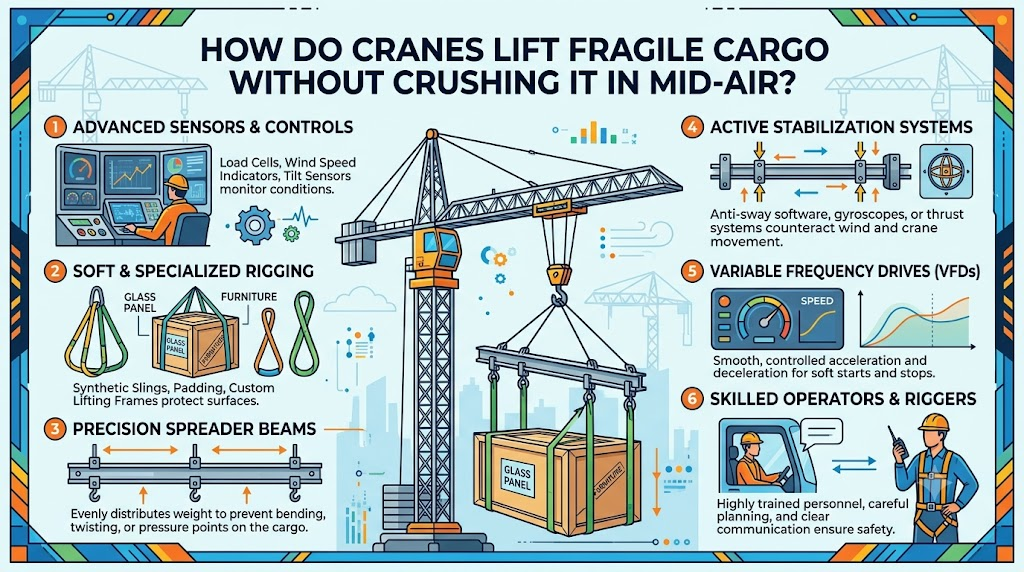
Whenever you watch a massive construction site in operation, the sheer scale of the equipment is mesmerizing. Tower cranes gracefully hoist multi-ton concrete panels, giant shipping containers, and even fully prefabricated modular rooms hundreds of feet into the air. To the casual observer on the street, the process looks incredibly straightforward. A crane drops a hook, workers attach a few steel cables to the corners of the object, and the machine simply pulls upward to defeat gravity.
However, anyone involved in mechanical engineering or industrial rigging knows that gravity is only half the battle. The most dangerous element of a heavy lift is not the downward pull of the earth. The true danger is a hidden, horizontal physics problem that has the potential to snap a fifty-ton cargo load like a dry twig.
The Physics of the Sling Squeeze
To understand this invisible threat, you have to look closely at the geometry of a standard crane lift. Most cranes operate using a single primary hook block that drops from the boom. If a rigging crew wants to lift a large, rectangular object like a shipping container, they cannot just attach a single cable to the center. The load would instantly spin out of control or tilt violently.
Instead, they must attach slings or cables from that single central hook down to the four outer corners of the cargo. This creates a distinct triangle shape, or a pyramid, made of steel wire.
This geometric setup solves the balance problem, but it introduces a terrifying new force known as horizontal compression. When the crane pulls up on the central hook, the angled cables pull upward on the cargo, but they also pull aggressively inward toward the center.
The heavier the object, and the shallower the angle of those cables, the greater the inward squeezing force becomes. If you are lifting a solid block of granite, this inward squeeze does not matter much. However, if you are lifting a hollow yacht hull, a delicate aerospace fuselage, or a thin-walled industrial generator, that compressive force is catastrophic. The angled cables will squeeze the upper edges of the load together with tens of thousands of pounds of pressure, crushing the cargo long before it ever clears the ground.
The Engineering Solution to Compression
To safely move fragile or hollow cargo, riggers must completely eliminate this inward squeezing force. The lifting cables that attach directly to the cargo must drop perfectly straight down, vertically, rather than angling back up to a central point.
Achieving this requires inserting a structural mediator between the crane hook and the cargo. This is where the concept of a spreader system comes into play.
A spreader system acts as a physical barrier against the crushing forces of the angled cables. Instead of attaching the cables directly to the delicate cargo, the cables from the crane hook are attached to the ends of a heavy steel bar. This bar takes the entirety of the inward compressive “squeeze.”
Because steel is incredibly strong under direct compression, the bar absorbs the horizontal forces without bending. Then, secondary slings are dropped from the ends of the bar directly down to the load. Because these lower slings are perfectly vertical, they apply zero inward pressure on the cargo. The delicate object experiences nothing but a gentle, upward lift, perfectly isolated from the violent geometry happening just a few feet above it.
The Shift to Modular Versatility
Historically, creating these physical barriers was an expensive and cumbersome process. If a construction company needed to lift a thirty-foot load, they would have to commission a fabrication shop to weld a massive, thirty-foot-long solid steel beam. This bespoke equipment was incredibly heavy, difficult to transport to the job site, and entirely useless if the next job required lifting a twenty-foot load.
The industry desperately needed a system that offered the immense compressive strength of solid steel but with the flexibility of a modern toolkit.
The solution arrived through modular engineering. Today, highly adaptable beam assemblies have largely replaced fixed, welded structures on job sites around the world. Instead of using a single giant piece of steel, these systems utilize a pair of specialized steel end caps. These heavy-duty caps are designed to slip over the ends of standard, off-the-shelf structural steel pipes.
This modularity fundamentally changed heavy logistics. If a crew needs to lift a narrow load, they insert a short length of steel pipe between the two end caps, secure the pins, and execute the lift. If the very next truck delivers a cargo load that is twice as wide, they do not need to order a new piece of equipment. They simply remove the short pipe, slide the end caps onto a much longer pipe, and continue working.
Material Science and Safety Margins
The success of these modular systems relies entirely on precise material science and rigorous safety testing. The end caps are subjected to massive, unpredictable dynamic loads. A sudden gust of wind or a slight jerk from the crane operator can multiply the compressive forces in a fraction of a second.
To survive this, the hardware is typically manufactured using high-yield alloy steel. Furthermore, every component is rigorously proof-tested, often loaded to 125 percent of its maximum rated capacity in a controlled laboratory environment before it ever reaches a construction site. This ensures that the metal will not deform, crack, or fail under the intense pressures of a real-world lift.
Protecting the Supply Chain
As global supply chains become more complex, the objects we need to move are becoming larger, heavier, and significantly more expensive. From offshore wind turbine blades to prefabricated hospital wings, the demand for safe, efficient lifting technology has never been higher.
The next time you look up and see a massive, fragile object floating seemingly weightless above a city skyline, look closely at the hardware suspended just above it. You are not just witnessing a demonstration of brute lifting power. You are looking at a brilliant, modular solution to a complex physics problem, quietly taking the pressure off the cargo so the world can keep building upward.