Macro photography is of incredible importance, you know very well, when it comes to taking jewelry photos, but how macro level do you think you need to go?
You feel that to practice the best photography, you need the best gear, but the thing is, you often struggle to figure out exactly from what perspective this best should be. For example:
- Shiny objects like gemstones need white balance to retain their originality, but how much should you set it?
- You can sharpen tiny ornaments by modifying the aperture, but within what range will the sharpness not become overly polished?
- Jewelry photo editing services can get you rid of all the unwanted spots and reflections, but which one of them specifically does this without destroying the characteristic flaws of the jewelry?
Keep reading; you will find answers to the most pressing questions, including these, right here on this blog.
TL;DR:
- You’ll need to lean into macro photography to reveal the details of the jewelry, and tailor your lighting setup to bring out its elegance. And these collectively will drive your gear and photo retouching services selection.
- When retouching jewelry, you will aim to remove all unwanted imperfections without compromising the gemstone’s original properties. In continuation of this, you will focus on its device and platform compatibility.
Best Practices at a Glance for Getting Quality Jewelry Photos
| Factors to emphasize | Best practices you need to maintain |
| Camera and gears | Getting a 105mm lensSturdy tripodMicrofiber gloves |
| Lighting setup | White foam boardJewelry light tent/lightboxPoint source LED5500K white balance |
| Sharpness of tiny ornamentsColor in multiple device screens | Aperture between f/8 and f/11Focus stackingManual white balance |
| Photo editing and retouching | Clipping pathsJewelry retouchingColor matching |
| Platform-readiness | White background (Amazon FBA)Balancing lifestyle and studio shots (Etsy and Shopify)Fast loading images (WooCommerce)360° product views and reel video (Instagram and TikTok) |
Get the Detail Captureable Camera and Gears
When the target of your shot is jewelry, you are better off leaning towards macro photography. You must be thinking of Nikon or Canon; yes, whether it is DSLR or mirrorless, you are half right, but the point is not here; the point is the lens, which should be as macro as 105mm.
A sturdy tripod is enough to stabilize your product and its background. Next is the important thing to ensure the free flow of natural light at home, and here, a jewelry light tent or lightbox will be a great attachment to your studio setup.
Studio cleaning is essential, but make sure that you do not leave fingerprints while cleaning. For this, you should always trust microfiber gloves. Before you finally touch the shutter, do a test to see if everything is in focus. Take advantage of small focus stacking or aperture.
Get the Light that Falls on and Reflects Off Under Control
A white foam board surround works well to block reflections. You can also surround the jewelry with a light tent. It’s okay to have extra light on the backdrop, but it’s better; you’ll get a clean white background.
You need to be careful when you’re lighting the gemstone, because you’ll need to shine light directly on its surface. What to do here? Use a specific point source LED.
Worried about the white balance being too low or too high to highlight the originality of your jewelry? Here, take the exact figure: 5500K. This applies to silver, gold, as well as any alloy.
And, if you can do this, you will be done with the problems raised from the shiny or polished surface, but the diamond won’t lose its metallic smoothness and brilliance.
Focus Stacking and Manual White Balance in Photoshop
Place items like earrings or small rings in the sweet spot, and you’ll see that you’re getting good results in terms of sharpness. How do you get that spot? Just keep your lens aperture between f/8 and f/11.
At this macro level, you don’t want to be limited to a single shot, because it’s essential to get all of the tiny item parts in focus. And you can do this in your favorite image editing software, Photoshop, through a process called focus stacking.
When you’re creating quality visuals of gold and silver, you definitely don’t want to focus on just one device screen. The original color must be the same regardless of the screen, right? Photoshop’s white balance will do the trick, but keep in mind that you’ll have to do it manually.
Achieve White Background, Distractionlessness, and Original Color
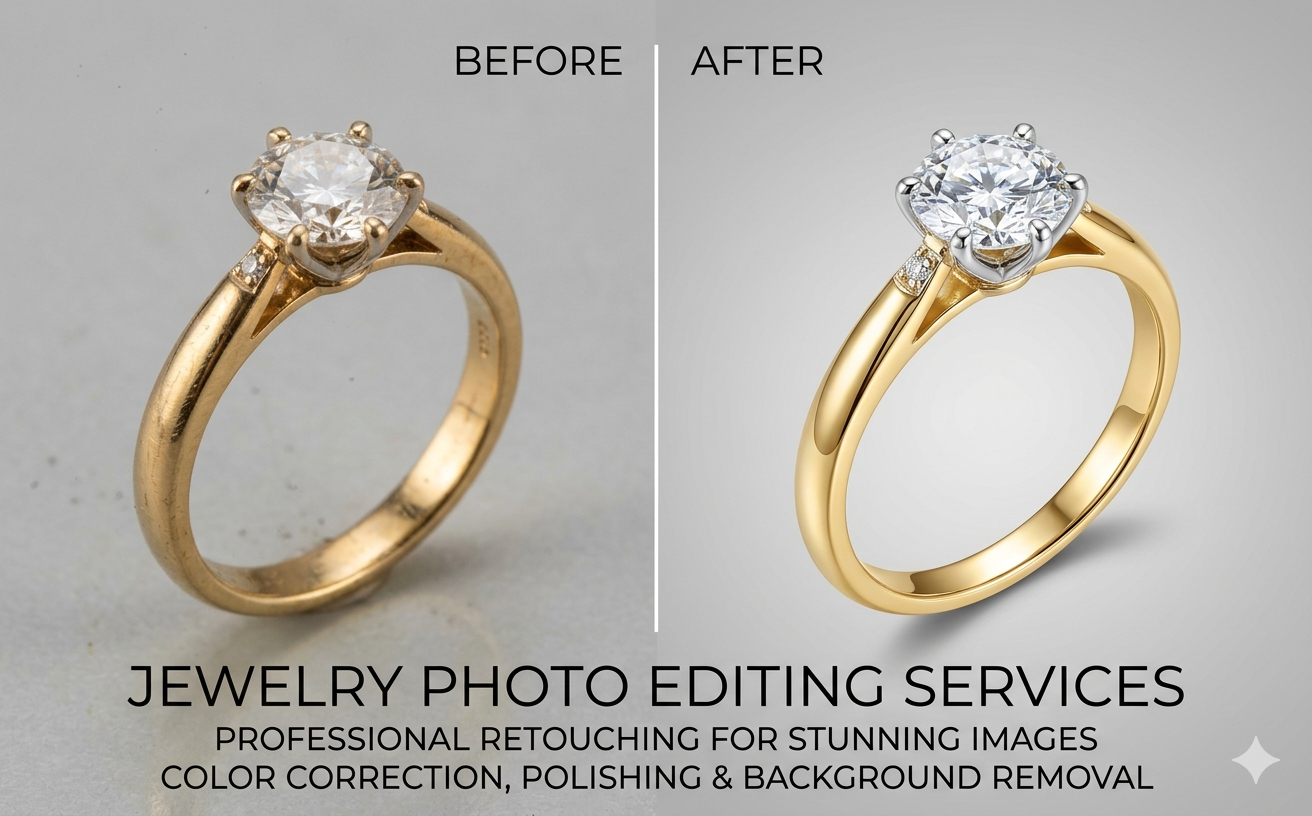
These are the goals you will pay for jewelry photo editing services to achieve. Clipping paths will provide white backgrounds, and jewelry retouching will remove all unwanted spots and reflections, while preserving the natural imperfections of the jewelry.
Increase clarity and contrast carefully enough to ensure you don’t need to resort to additional editing to make the gemstone shine.
Photoshop doesn’t have to be your only resort for color matching; there are other capable options out there, like Capture One and Lightroom.
Plus, trending AI image editing can take you even further; just be sure to keep the human touch. Overall, this hybrid editing will take your goal of original and clean product visuals so far that your gemstones can get a style of luxury brands like Cartier and Tiffany.
Give Jewelry Photos Platform-Ready Touches
You know very well that not all ecommerce platforms follow the same visual guidelines, so you need to tailor your optimization to the specific platform.
- Amazon FBA: This popular ecommerce site makes a clean, white background mandatory, unlike other sites.
- Etsy and Shopify: In these cases, you see that the size and shape of the product are very important. And so, you have to balance lifestyle and studio shots in this case.
- WooCommerce: To target these sites, you must export your images in WebP format after editing. Otherwise, your images will be disqualified from the platform’s fast loading image validation.
- Instagram and TikTok: When it comes to jewelry photography, these two especially strongly demand 360° product views. Plus, if you can add reel videos, user engagement starts to skyrocket.
Frequently Asked Questions about Jewelry Photography and Retouching
1. What lens should I choose for jewelry photography?
Since you need to focus on macro photography when photographing jewelry, you should use a 105mm lens on your camera. This will be a great addition to your gear to capture the finer details.
2. What is the exact white balance setting I should use for taking pictures of silver, gold, or diamonds?
To photograph shiny objects like silver, gold, or diamonds, you should set the white balance to 5500K. At this setting, you won’t have problems with the polished surface of the gemstones, and also their features will be captured intact in the camera.
3. What is the best practice for getting photos with quality sharpness for small rings or earrings?
For tiny ornaments like earrings or small rings, the best way to get photos with high sharpness is to place them in the sweet spot of the camera lens. To do this, you need to set the lens aperture to between f/8 and f/11.
4. What photo editing is used to give a white background to a product?
Clipping path is the primary photo editing process through which the product is separated from the prevailing clutter background and placed on a white background.
5. Should I focus on lifestyle shots when doing the photography for Shopify or Etsy platforms?
Not only lifestyle, but you also have to keep in mind the studio shot aspect. The best practice is if you go for balancing both and take a quality shot.
In a Nutshell
A 105mm lens gives you a huge boost in your preparation for diving into the macro level to take photos of your jewelry. The 5500K white balance setting is just as important to you as manually adjusting the white balance during retouching.
Light tent, lightbox, or white foam board goes the extra mile to protect your gemstone photos from messy reflections. Clipping path comes in favor of the white background for your images that follow Amazon FBA guidelines.
And, jewelry retouching, of course, takes care of removing unwanted distractions while keeping the real properties intact. Above all, you’ll want to keep your photos ready for ecommerce and social media platforms.
After all photoshoots and retouching, as you know, the real goal is to present your jewelry to a wider audience.