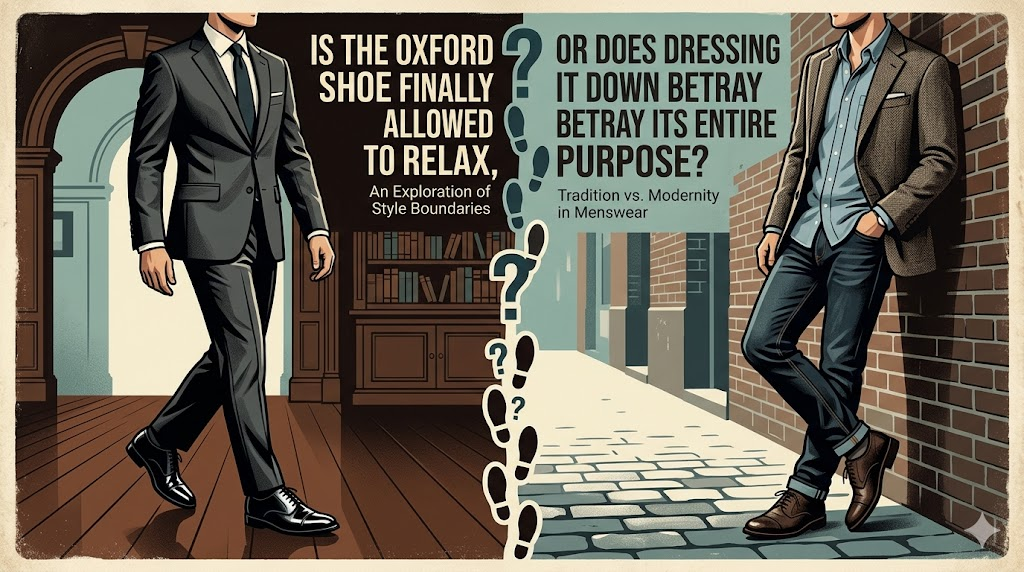
For nearly two centuries, the Oxford stood as the undisputed peak of men’s formal footwear. Now Italian craftsmen and a new generation of wearers are asking whether that hierarchy ever really made sense.
The Oxford shoe has a reputation problem. Not the kind that comes from bad press or changing tastes, but the kind that comes from being too good at one thing for too long. Since the 1800s, when students at the University of Oxford began adopting low-cut, closed-lacing shoes as a more comfortable alternative to the heavy boots of the era, the Oxford has been understood as a formal object. A disciplined object. A shoe that, in the minds of most men who think about these things, belongs beneath a suit and nowhere else. That understanding has been remarkably persistent, and it has also been, for quite some time, quietly wrong.
The formality of an Oxford is real but conditional. It derives primarily from two things: the closed lacing system, in which the two facing panels are stitched beneath the vamp so the shoe sits snugly across the instep; and the cultural associations that have accumulated around that construction over nearly two centuries of use in law courts, boardrooms, and black-tie affairs. Remove those associations, or subject them to the kind of scrutiny that a changing professional culture increasingly demands, and what you are left with is a silhouette — a long, low, clean shape — that is genuinely one of the most elegant a shoe can take.
That silhouette does not inherently require a suit to justify itself. The question is whether the shoe wearing it has been made to survive outside formal contexts. And that is exactly where material and construction stop being technical details and start being the entire argument.
Consider what happens to a traditional black calf Oxford with a leather sole when it encounters the actual texture of daily life in 2026. It performs beautifully at a dinner or a client meeting. On a wet Houston sidewalk in June, on a subway platform, on the walk from a parking garage to a restaurant that turns out to be several blocks farther than Google suggested, it begins to reveal its limitations. The leather sole offers almost no traction on wet surfaces. The uncompromising structure, which is what makes it look so composed under a suit, fights against the natural movement of the foot. The shoe is giving you a message: I was not designed for this. Please return me to appropriate conditions.
This is not a failure of the Oxford as a concept. It is a failure of the assumption that one material and construction approach can serve the full range of occasions that a man in 2026 actually encounters. The solution Italian shoemakers have increasingly gravitated toward is not to abandon the Oxford’s refined silhouette but to rebuild it from the sole up — starting with what it needs to do rather than what it has always been.
“The solution is not to abandon the Oxford’s refined silhouette but to rebuild it from the sole up — starting with what it needs to do rather than what it has always been.”
A flexible rubber sole changes everything about where a lace-up dress shoe can go. It absorbs impact rather than transmitting it. It grips varied surfaces without the wearer thinking about it. It allows the foot to move through its natural range of motion, which means that wearing a well-made dress shoe for a full day does not need to be an act of endurance. The rubber sole is, in this sense, an act of honesty: an admission that the man wearing the shoe has a real day ahead of him, not a ceremonial one.
Burnished leather tells a similar story from the upper half of the shoe. Traditional dress leather is chosen and finished for uniformity — a flat, consistent color that reads as authoritative and controlled. Burnishing introduces depth and variation, a deliberate richness that implies lived experience rather than pristine formality. The tonal complexity of burnished brown calfskin, in particular, carries references that formal polish deliberately avoids: it suggests age without looking worn, warmth without casualness, care without preciousness. It is the visual equivalent of a well-chosen word that does more work than a louder one would.
Santoni, the family-owned Italian house founded in Corridonia in 1975, has made hand-burnishing a central part of its identity precisely because the house understands that finish is not decoration. It is information. Every artisan at Santoni applies color by hand, which means that no two pairs are identical, and that the gradient effects achieved — the way color deepens at the toe, lightens across the vamp, darkens again at the heel — are the product of a human judgment that no industrial process can replicate. When that level of attention is directed toward a shoe designed not for a state dinner but for the texture of ordinary sophisticated life, the result is something that refuses to be dismissed as merely casual and refuses to be confined as merely formal.
The round toe is part of this argument too, though it tends to get less attention than lacing systems and sole constructions. The pointed toe, which has appeared and disappeared from men’s dress shoes in various cycles of fashion, communicates sharpness and intention — qualities appropriate to a power context, less so to an afternoon that is supposed to feel unconstrained. The round toe is gentler, more democratic in its proportions, more compatible with the relaxed tailoring that has come to define the best of how men dress now. It does not announce itself. It completes an outfit without overwhelming it.
All of which brings us back to the original question: is dressing down a dress shoe a betrayal of its purpose? The answer, if you accept that the purpose of any well-made shoe is to serve its wearer rather than to perform a category, is no. The best casual oxford shoes are not compromises between form and function — they are arguments that the distinction between those two things has never been as clean as the taxonomy of men’s footwear has traditionally insisted.
There is something worth saying about the broader cultural moment this conversation sits inside. The leveling of dress codes that accelerated through the early 2020s has not, despite considerable anxiety at the time, resulted in a collapse of sartorial standards. What it has produced is a more honest relationship between what a man wears and the life he actually leads. Men are not dressing less carefully; they are dressing more accurately. The suit reserved for a single occasion is less interesting, practically speaking, than the shoe worn intelligently across many. The question is not whether you can dress an Oxford down. It is whether the Oxford you have chosen was built to be useful to you, or only to be correct.
An Italian craftsman who burnishes leather by hand and fits it over a rubber sole for a shoe retailing at this price point has already answered that question. The rest is just deciding whether you were asking it.